

Indoor Air Quality in Winter: Humidity, Dust & Stuffiness
Why GTA and Toronto homes feel dry, dusty, and stuffy every winter — and how to fix indoor air quality with humidity control, filtration, and fresh-air ventilation.
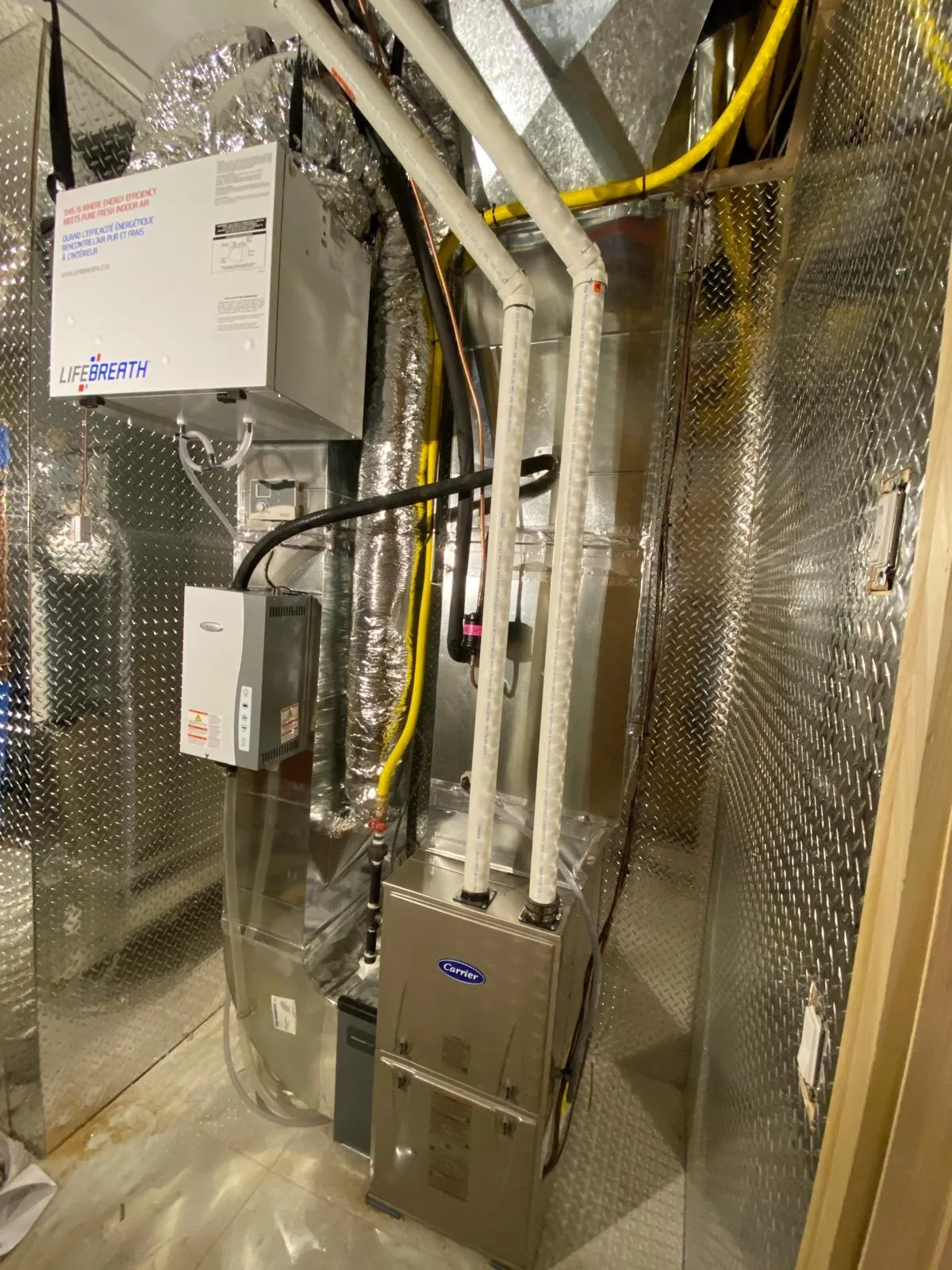
By February, a lot of GTA homes start to feel the same way: the air is dry enough to crack your lips, every doorknob delivers a static shock, a fine layer of dust keeps settling no matter how often you wipe, and yet the whole house somehow feels stuffy and stale at the same time.
It seems contradictory — too dry and too stuffy — but it’s exactly what an Ontario winter does to the air inside a sealed, forced-air home. The good news is that each of these problems has a clear cause and a practical fix.
The short version: Winter air feels dry because cold outdoor air holds little moisture and your furnace dries it further; it feels dusty and stuffy because the same air keeps recirculating. Target 30–50% relative humidity, add a whole-home humidifier, keep up with filter changes, and bring in fresh air with an HRV or ERV. Want it sorted before next winter? Get in touch.
Why winter air feels so dry in the GTA
Cold air is dry air. When it’s −15 °C outside, the outdoor air holds almost no moisture — and when your furnace warms that air to a cozy 21 °C, the relative humidity drops even lower. You can easily end up sitting in air that’s under 20% humidity, drier than many deserts.
Modern homes make it worse. Today’s GTA houses are built and renovated to be tightly sealed for energy efficiency, which is great for your heating bill but means there’s very little natural air exchange to bring in or balance moisture. The same dry, heated air just keeps circulating.
You feel the result as itchy skin, chapped lips, scratchy throats, more frequent static shocks, and even shrinking gaps opening up in hardwood floors and wood furniture.
Why it feels dusty and stuffy too
Here’s the part that surprises people. The dryness and the dust and stuffiness all trace back to the same root cause: recirculated air with not much fresh air coming in.
- Dust builds up because your forced-air system moves the same air over and over. Anything not captured by the filter — fine particles, dander, dead skin, fibres — gets stirred up and redeposited around the house.
- Stuffiness is a sign of stale air: rising carbon dioxide, cooking and bathroom odours, and off-gassing from furniture and finishes that have nowhere to escape in a sealed home.
So the winter air problem is really three problems wearing one coat: it’s too dry, too dusty, and too stale. Each needs its own solution.
The ideal indoor humidity (and why lower in deep cold)
For comfort and health, aim for roughly 30–50% relative humidity through the heating season. That range keeps skin and airways comfortable, reduces static, and helps wood floors and trim stay stable.
But there’s an important caveat for cold snaps. When it’s bitterly cold outside, your window glass gets very cold — and warm, humid indoor air will condense on it, leaving moisture that can drip, freeze, and eventually feed mould or rot around the frames.
The deep-cold rule: if you see condensation or frost forming on the inside of your windows, your indoor humidity is too high for the outdoor temperature. Lower the humidifier setting toward 30% or less until the windows clear. Healthy humidity is a moving target that drops as the mercury does.
Dry, dusty, stuffy: causes and fixes at a glance
| Problem | Cause | Solution |
|---|---|---|
| Dry air | Cold outdoor air holds little moisture; furnace heat lowers relative humidity further | Whole-home humidifier (bypass or steam) targeting 30–50% RH |
| Dust | Same air recirculated through the ductwork; poor filtration | Higher-MERV filtration, regular filter changes, duct cleaning |
| Stuffiness / stale air | Tightly sealed home with little fresh-air exchange | HRV or ERV to bring in fresh air without losing heat |
| Static shocks | Very low humidity lets static charge build up | Raise humidity into the target range with a humidifier |
Solution 1: whole-home humidifiers
A portable tabletop humidifier can take the edge off one room, but it won’t fix a whole house — and it needs constant refilling and cleaning. For a real solution, a whole-home humidifier installs directly onto your furnace and ductwork, adding moisture to the warm air as it’s distributed.
There are two common types:
- Bypass humidifiers — water flows over an evaporator pad, and a portion of furnace airflow is routed through it to pick up moisture. Affordable and effective for most homes.
- Steam humidifiers — these actively boil water to produce clean steam, giving precise control and higher output. A strong choice for larger or very dry homes.
A built-in humidistat lets you dial in your target humidity, and the better setups can adjust automatically as the outdoor temperature changes — exactly what you want for that deep-cold window-condensation balance.
Solution 2: better filtration and duct cleaning
Humidity won’t touch your dust problem — filtration will. The filter is your system’s first line of defence, and a clean, appropriately rated filter captures far more of the particles being pushed around your home.
Choosing the right filter is a balance between capturing fine particles and not choking your furnace’s airflow. We cover exactly how to weigh that in our guide to how often to replace your furnace filter and matching the MERV rating to your equipment.
For deeper buildup, a professional duct cleaning clears out the dust, debris, and allergens that have settled inside the ductwork itself over the years — so your system isn’t redistributing them every time the blower runs. It’s also worth doing after a renovation.
If certain rooms always feel dustier, stuffier, or just off compared to the rest of the house, the airflow itself may be unbalanced — something we dig into in our piece on uneven heating and cooling between rooms.
Solution 3: fresh air with an HRV or ERV
This is the missing piece for stuffiness in a sealed home. A heat recovery ventilator (HRV) continuously exhausts stale indoor air and brings in fresh outdoor air — but it passes the two air streams past each other so the outgoing warm air pre-heats the incoming cold air. You get fresh air without dumping your heating out the window.
An ERV (energy recovery ventilator) does the same while also transferring some humidity, which helps keep things balanced in both winter dryness and summer humidity.
Either one directly attacks stale air, lingering odours, and rising carbon dioxide — the real sources of that stuffy feeling.
Solution 4: purification and source control
A couple of extras round things out:
- UV purification — a UV light installed in the ductwork helps control mould, bacteria, and other microbes on the cooling coil and in the airstream, supporting cleaner air overall.
- Source control — the simplest wins: run kitchen and bathroom exhaust fans, store cleaning chemicals sealed, choose low-VOC finishes, and keep dust down at the source. Every bit you stop at the source is air your system doesn’t have to clean.
A word on combustion safety
While you’re sealing and balancing your home for winter comfort, keep one safety principle front of mind.
Never block, cover, or seal off the combustion air or venting for a gas furnace, water heater, or fireplace in the name of stopping drafts. These appliances need a proper air supply to burn safely, and starving them can produce carbon monoxide. Make sure you have working CO detectors on every level of your home and replace them per the manufacturer’s date. If a detector ever sounds, get everyone outside and call for help.
This is exactly the kind of work that should be handled by TSSA-licensed technicians, never improvised.
When to call Delson Air
Winter air quality isn’t one fix — it’s getting humidity, filtration, and fresh-air ventilation working together for your specific home. That’s where professional assessment pays off.
Delson Air is a licensed, insured, TSSA-licensed and Enbridge Authorized Contractor serving Toronto, Mississauga, Markham, Vaughan, Brampton, Richmond Hill, Oakville and the surrounding GTA. We can recommend and install the right whole-home humidifier, filtration upgrade, HRV/ERV, or UV system, and clean your ducts so your air actually feels fresh again. Explore our air quality and HVAC services, or reach out for an honest assessment.
Call us at (647) 467-9919 or book through our contact page. Your Comfort, Our Priority.
FAQ
Common questions
What is the ideal indoor humidity in winter?
Why is my house so dry in the winter?
Does a humidifier help with dust and stuffiness?
What is an HRV and do I need one?
Delson Air Team
Licensed, insured, TSSA-certified HVAC technicians serving the Greater Toronto Area.
Keep reading
More from the Journal
Indoor Air Quality During Wildfire Smoke Season in Ontario
When wildfire smoke drifts over the GTA and Ontario, here's how to keep indoor air clean — HEPA, MERV 13+ filtration, sealing leaks, and running your HVAC the right way.
Summer Indoor Humidity Levels: Comfort Guide for GTA Homes
What ideal summer indoor humidity looks like for Toronto and GTA homes, why 30–50% is the comfort sweet spot, and how your AC and dehumidifier get you there.
Heat Pump vs Furnace + AC: True 10-Year Cost of Ownership
Heat pump vs furnace + AC 10-year cost of ownership for GTA and Ontario homes: install, operating, maintenance, rebates, and lifetime totals compared in 2026.